
There is something wonderfully meditative about making a color mixing chart. The slow rhythm of dipping your brush, adding just a touch more pigment, and watching two colors swirl together on your palette feels like taking a quiet walk through your paints. Every square you fill becomes a tiny discovery—a map of possibilities just waiting to happen in your next painting.
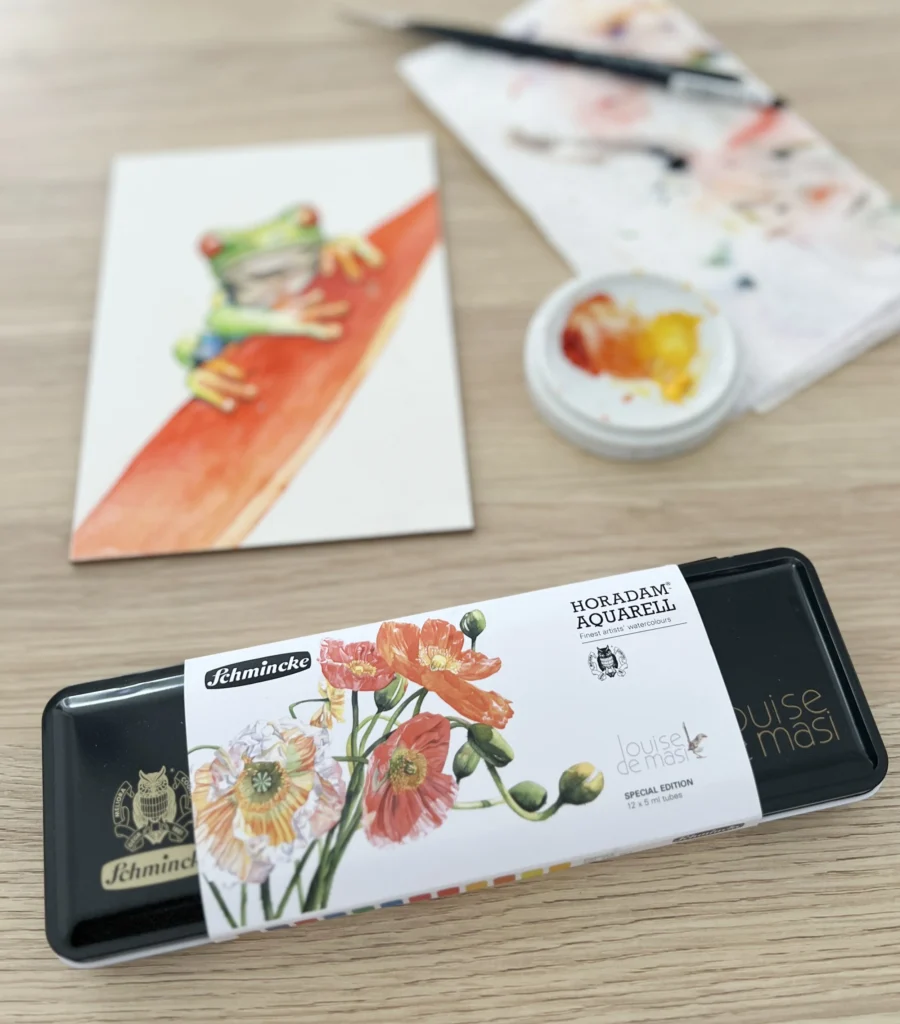
My custom palette from Schmincke.
When I first started watercolor painting, I used to think that simply owning a good set of paints was enough. I would squeeze out a little of this and a little of that, mixing by instinct and hoping they would cooperate. But more often than not, my bright washes would turn dull. I’d try to mix a soft green for a leaf and end up with something that looked like dishwater. It wasn’t the paints that were the problem; it was my lack of understanding of how they actually interacted.
Making a mixing chart changed everything for me. It became my most valuable reference and a quiet companion beside my palette. It reminds me exactly which pigments create those luminous greens, vibrant violets, and subtle neutrals I love so much. It is truly one of the best exercises you can do to understand your paints.
Today, I’m going to walk you through how to create your own watercolor mixing chart using the twelve colors from my custom Schmincke Horadam palette. This is the same set I use for most of my paintings. I’ll show you how to record the beautiful interactions between these pigments so your chart becomes a tool you’ll reach for again and again.
Why Make a Color Mixing Chart?
There’s an almost magical shift that happens when you see how two pigments combine. A transparent yellow suddenly turns into a deep olive when it meets a touch of French Ultramarine; a beautiful violet emerges from just a whisper of Ruby Red and French Ultramarine. When you understand these relationships, you stop guessing—you start choosing your colors with total confidence.
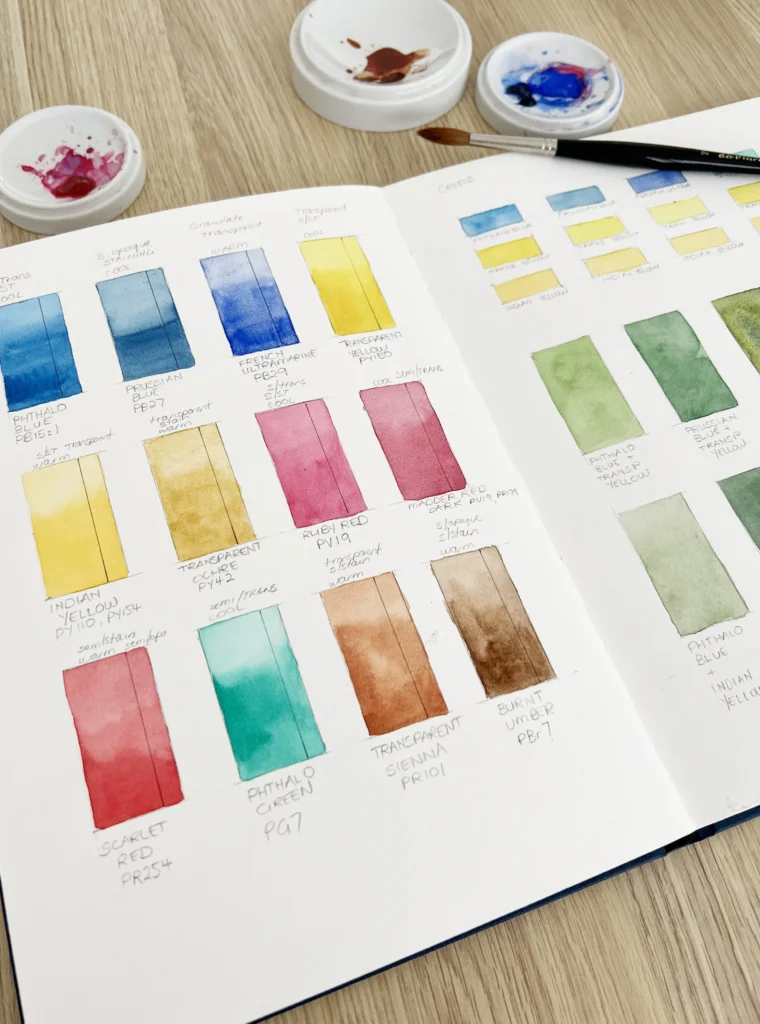
My mixed colours chart.
A color mixing chart helps you:
Truly learn your paints: Every pigment behaves differently. Some granulate (look textured), some stain the paper, while others are perfectly transparent or opaque.
Predict your results: You can mix precisely the shade you want before your brush even touches your painting.
Save time and money: You won’t waste precious pigment trying to “fix” a color that has already gone muddy.
Find harmony: When you mix from a limited palette, your paintings feel unified, professional, and balanced.
I often compare it to learning the notes on a piano. Once you know which notes blend beautifully, you can make music effortlessly.
💡 Pro Tip: Keep your chart nearby while you work. You’ll find yourself glancing at it constantly once you realize how reliable it is!
My Twelve Schmincke Colors
My custom palette contains twelve carefully chosen colors, all selected for their transparency, versatility, and ability to mix cleanly. Each one has its own unique character, and together they form a beautifully balanced range of warm and cool tones.
French Ultramarine (PB29): A rich, warm, granulating blue—perfect for adding texture and depth. I love pairing it with Transparent Sienna for soft grays and moody neutrals.
Phthalo Blue (PB15:1): A vibrant, cool blue with incredible tinting strength. It’s ideal for mixing fresh greens and clear skies.
Prussian Blue (PB27): A deep, slightly greenish blue. It is semi-opaque and very easy to control for shadows and water scenes.
Scarlet Red (PR254): A warm, glowing red that brings a “sunny” feel to florals and oranges.
Madder Red Dark (PV19, PR179): Cool, deep, and transparent. This one is perfect for layering and creating rich purples.
Ruby Red (PV19): A luminous, transparent cool red that really “sings” in floral and portrait work.
Transparent Yellow (PY150): Clear and fresh; excellent for glazing and keeping your mixes clean.
Indian Yellow (PY110, PY154): A warm, golden yellow that radiates light in any mixture.
Burnt Umber (PBr7): An earthy, semi-opaque neutral that provides a grounding base for deep shadows.
Transparent Sienna (PR101): A warm, glowing reddish-brown. This is my go-to for mixing those soft, natural grays.
Transparent Ochre (PY42): A gentle, earthy yellow. It’s transparent and ideal for capturing natural, organic tones.
Phthalo Green (PG7): A cool, strong green. It’s wonderful for vivid foliage but also creates deep shadows when “tamed” with reds or earth tones.
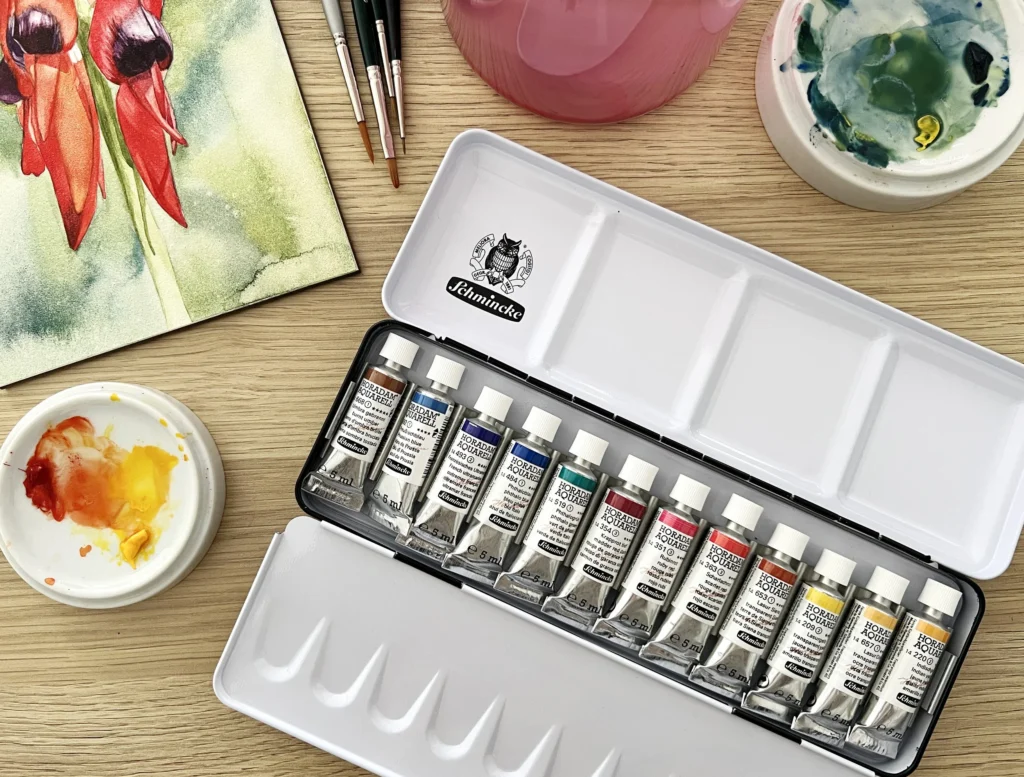
My custom Schmincke watercolour palette.
Each of these colors has a distinct personality, and the chart we’re about to make will show exactly how they interact.
If you don’t use Schmincke, you can easily find substitutes from other manufacturers. However, keep in mind that paint behavior can differ across brands—even when the pigment codes match. These are close substitutes, not perfect matches. Some brands use dual pigment codes (like PR101 & PO48) for their versions, so be sure to check the tube label. Mixing colors from other suppliers may give you a slightly different result than mine, but that is all part of the discovery!
| Color | Pigment Code | Substitutes (Winsor & Newton / Daniel Smith) | Substitute Pigment Code(s) |
| French Ultramarine | PB29 | French Ultramarine (W&N / DS) | PB29 |
| Phthalo Blue | PB15:1 | Winsor Blue (Green Shade) / Phthalo Blue (GS) | PB15 / PB15:3 |
| Prussian Blue | PB27 | Prussian Blue or Antwerp Blue (W&N / DS) | PB27 |
| Scarlet Red | PR254 | Winsor Red (W&N) / Pyrrol Red (DS) | PR254 |
| Madder Red Dark | PV19, PR179 | Permanent Alizarin Crimson (W&N / DS) | PR206 / PR177 |
| Ruby Red | PV19 | Permanent Rose (W&N) / Quinacridone Rose (DS) | PV19 |
| Transparent Yellow | PY150 | Transparent Yellow (W&N) / Nickel Azo Yellow (DS) | PY150 |
| Indian Yellow | PY110, PY154 | Indian Yellow (W&N / DS) | PO62, PY139 / PY97, PY150 |
| Burnt Umber | PBr7 | Burnt Umber (W&N / DS) | PBr7 |
| Transparent Sienna | PR101 | Burnt Sienna (W&N) / Burnt Sienna Light or Quin. Burnt Orange (DS) | PR101 / PO48 |
| Transparent Ochre | PY42 | Gold Ochre (W&N) / Transparent Yellow Oxide (DS) | PY42 |
| Phthalo Green | PG7 | Winsor Green (Blue Shade) / Phthalo Green (BS) | PG7 |
Preparing Your Materials
Before we start mixing, gather these essentials. Since this chart will be a long-term reference for your studio, using quality materials now will pay off later!
Watercolor Paper: I recommend 100% cotton, cold-press paper (A4 or A3 size). The surface should be smooth enough for clean swatches but still have enough “tooth” to hold the pigment properly.
Ruler and Pencil: You’ll need these to measure and draw your grid accurately.
Paints and Palette: Your 12 chosen colors and a clean mixing space.
Clean Water: It’s vital to keep your water fresh so your mixes stay vibrant.
Brushes: A fine round brush (Size 4–6) works perfectly for filling in precise squares.
Paper Towels: Essential for blotting excess water and cleaning your brush between colors.
💡 Pro Tip: Choose high-quality paper. Your chart isn’t just a scrap test; it’s a permanent tool. You want the paints to behave exactly as they would on a finished masterpiece!
Setting Up the Grid
For a 12-color palette, you will need to create a 13 × 13 grid. This gives you enough room for all your pigments plus a row and column for your labels.
Draw the grid in pencil: Use a light touch so the lines don’t distract from the colors later.
Leave the top-left square empty: This acts as the anchor for your chart.
Label your colors: Write the color names in the exact same order across the top row and down the left column.
Leave a small margin: If you have space, leave a little room around the edges for notes on pigment codes or transparency.
Paint your “Base Notes”: Start by filling the top row and the leftmost column with neat swatches of each pure pigment at full saturation. These squares show the “true” color before any mixing begins.
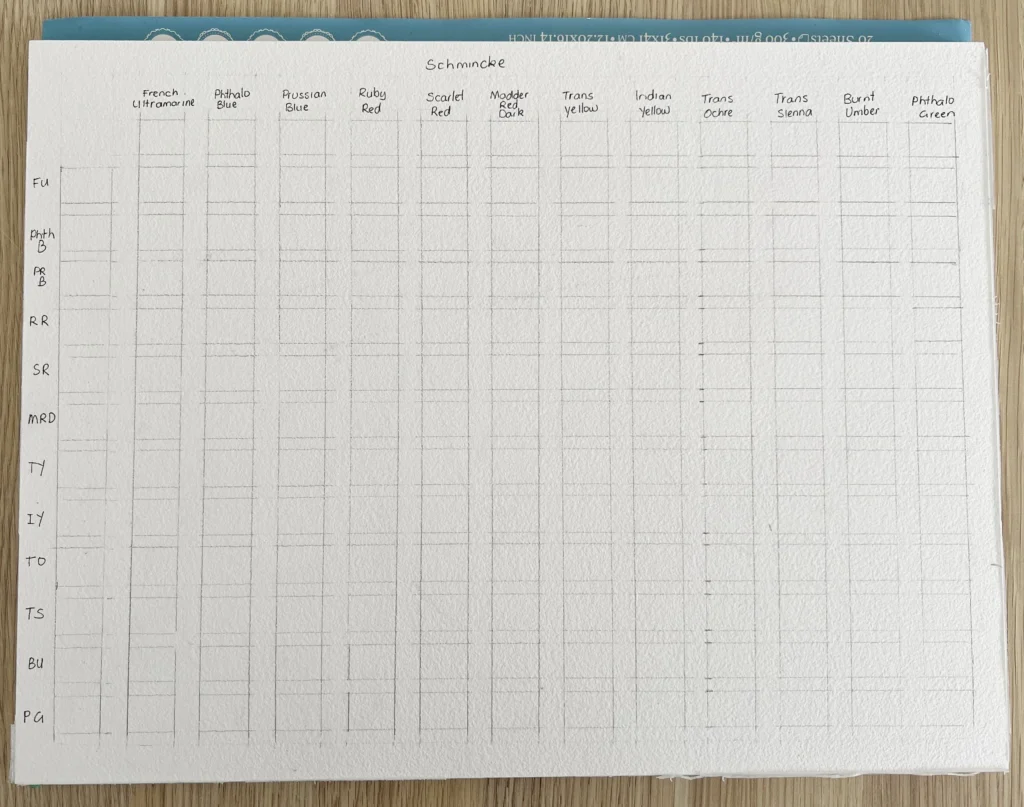
Setting out my grid pattern.
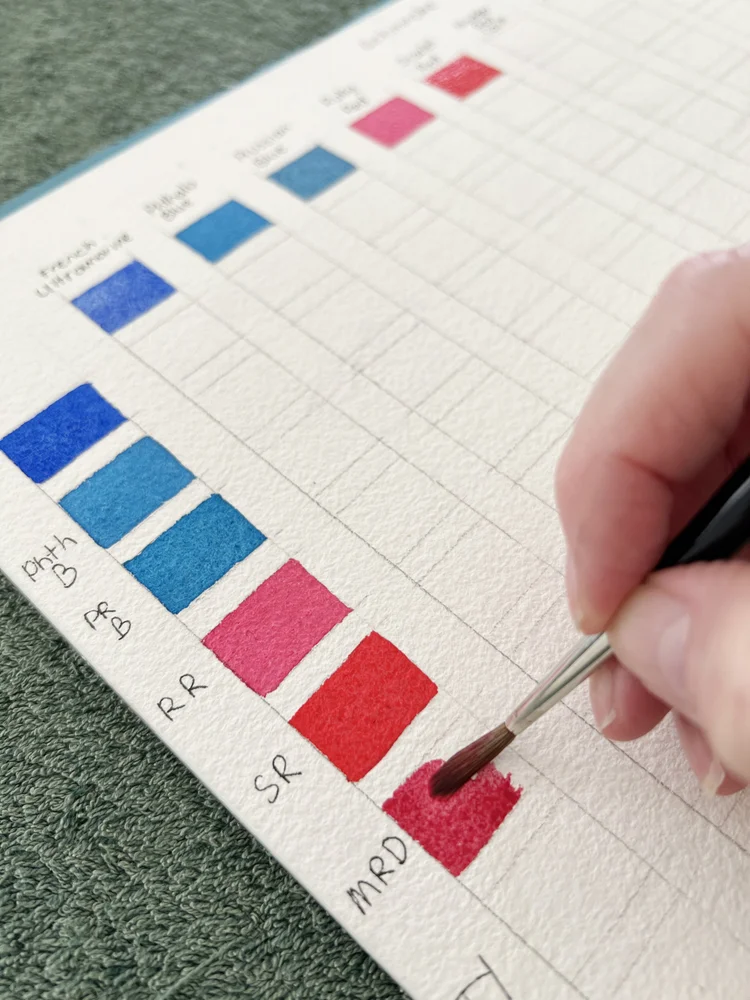
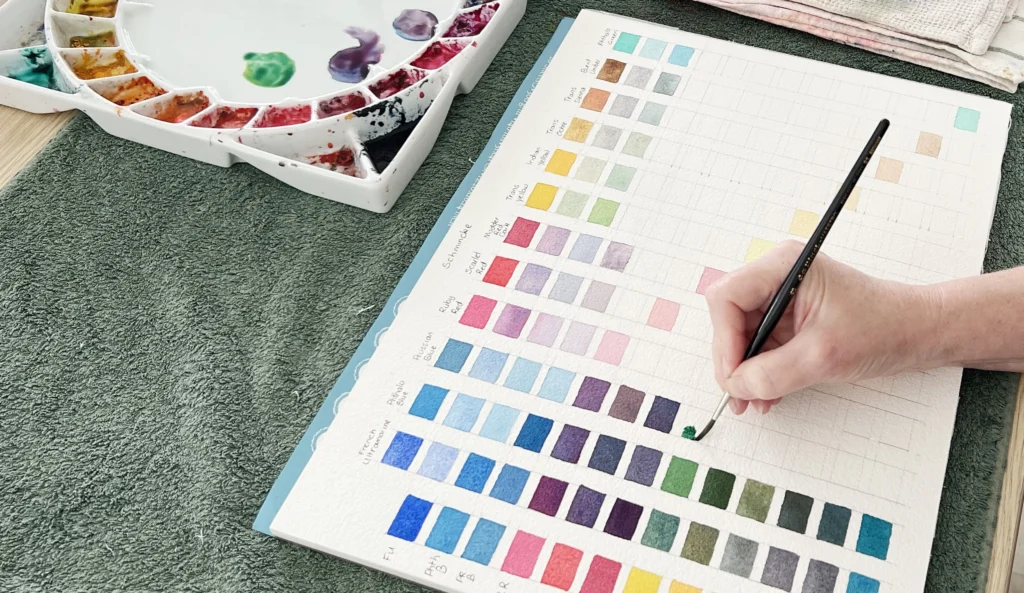
Filling the squares with paint.
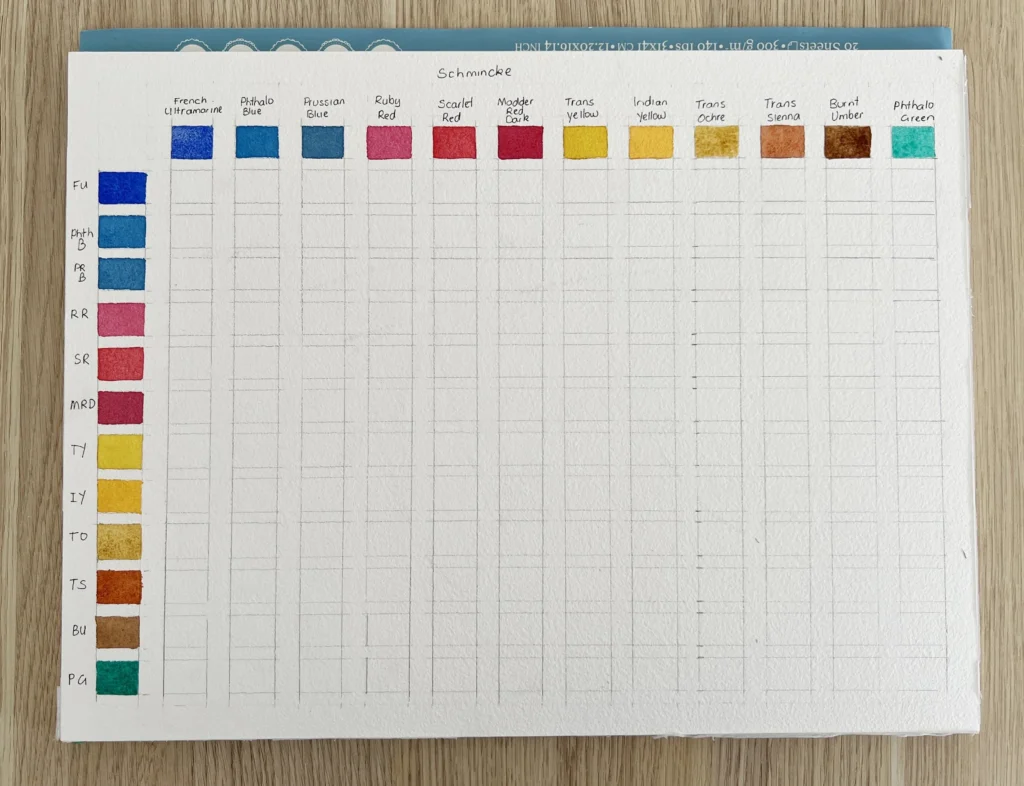
I have painted in the top row and the left column with the colours at their full intensity. Each colour is listed twice.
Filling the Chart: The Mixing Process
Now comes the fun part—watching the colors interact! There is a specific way to fill the squares where the same colors meet, creating what artists often call the “diagonal.”
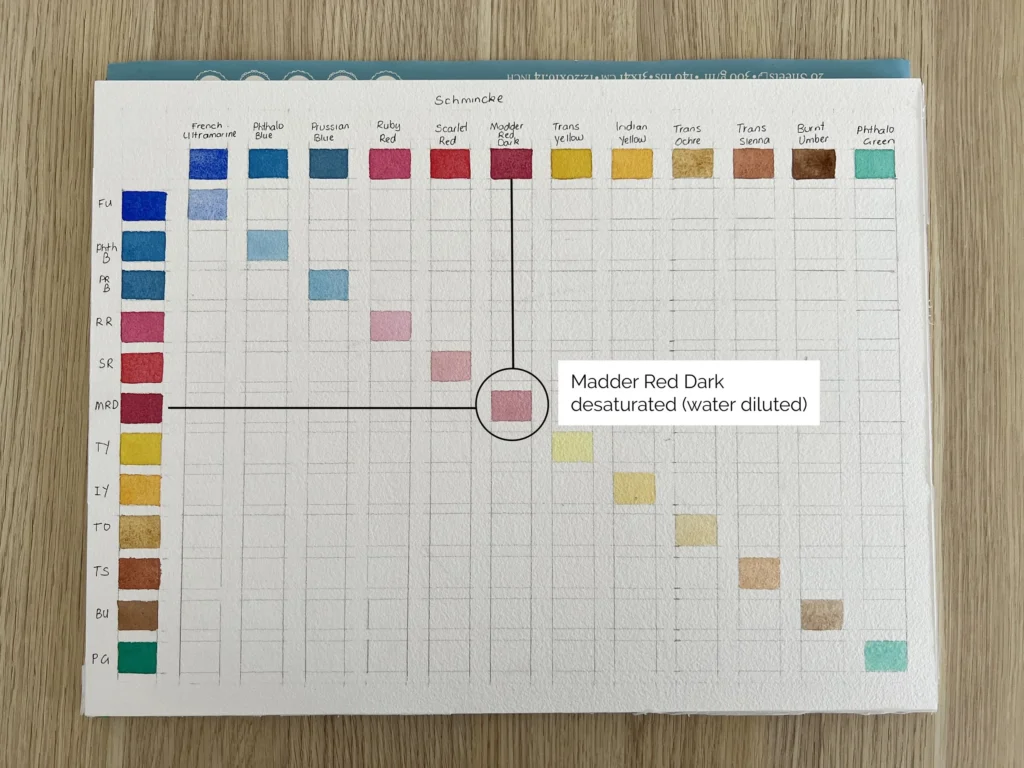
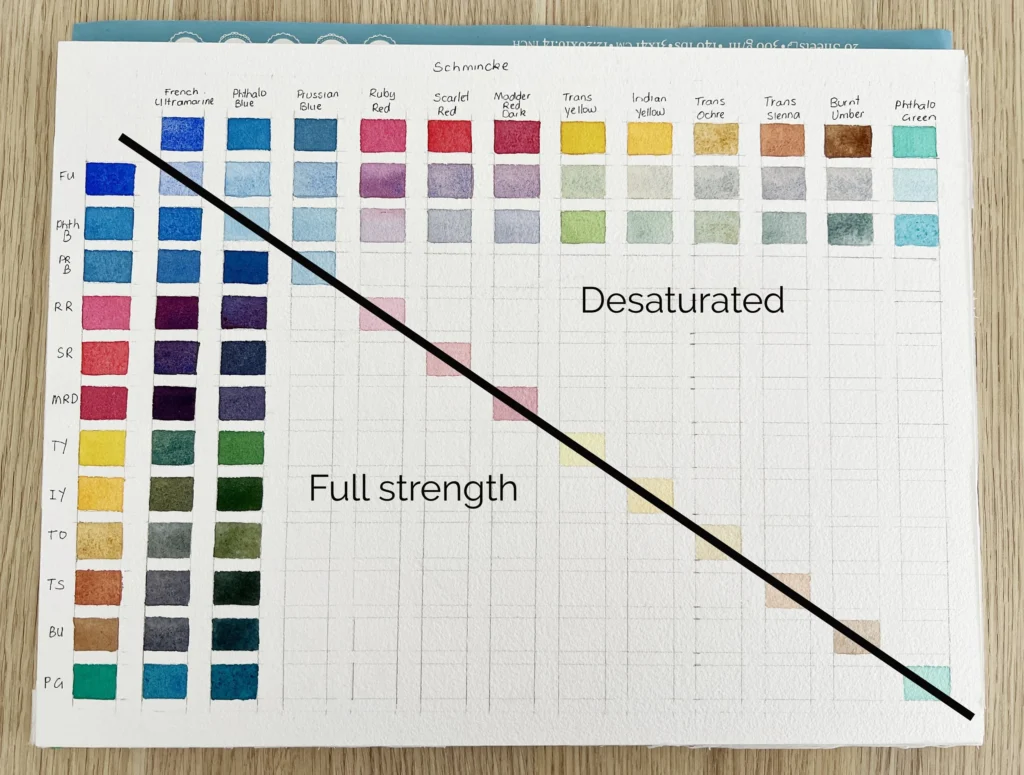
Painting the Light Values (The Diagonal) Where the same colors meet (for example, where the “French Ultramarine” row meets the “French Ultramarine” column), I don’t just repeat the full-strength color. Instead, I paint that single color in a lighter value.
By adding more water to dilute the paint, you create a soft wash of that pigment. This is incredibly helpful because it shows you exactly how transparent or subtle a color can look when it’s thinned down—essential for those delicate sky washes or soft floral highlights.
Starting Your Mixes
Now, you’ll fill in the rest of the grid by intersecting your colors. For each square, mix the pigment from the top row with the pigment from the left column.
For example, you’ll start by mixing Phthalo Blue with French Ultramarine, then Phthalo Blue with Prussian Blue, and so on.
Aim for a 50/50 Ratio: Try to keep your mixture balanced so you can see a “true” third color rather than one pigment dominating the other.
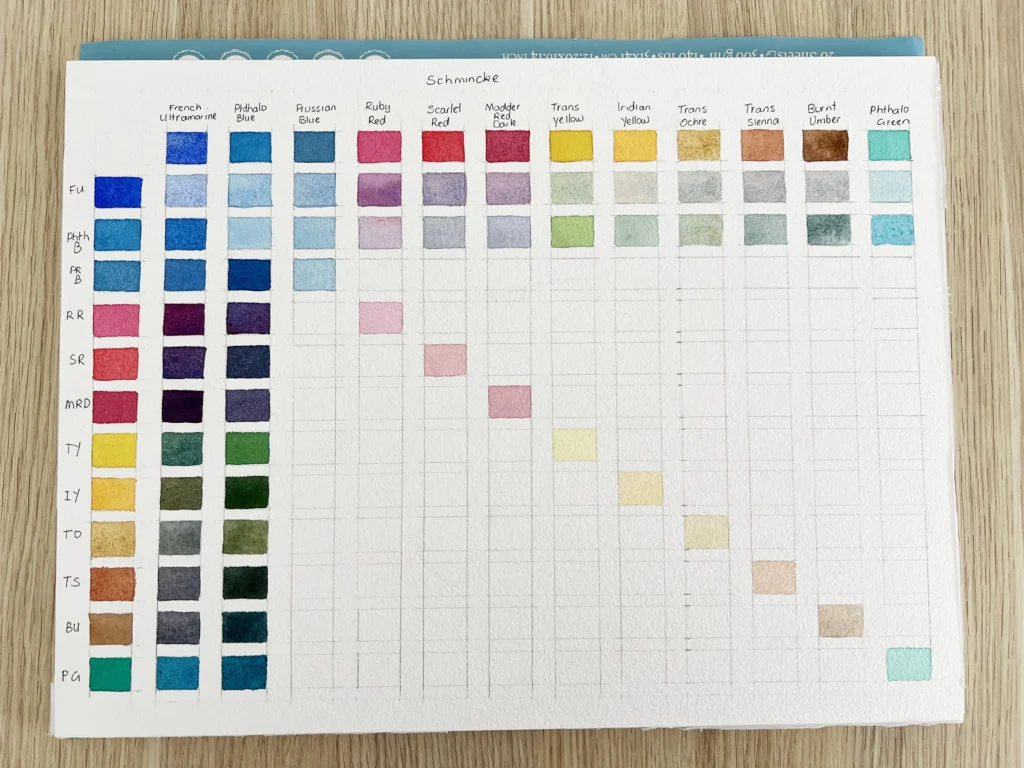
The “Full Strength” vs. “Transparent” Rule: You’ll notice that every mixture actually appears twice on your chart. To make the most of this, I use a specific system:
- Below the diagonal line: Paint the mixture at full strength (saturated).
- Above the diagonal line: Paint the exact same mixture but thinned with water.
This allows you to compare at a glance how each combination looks when it’s rich and moody versus when it’s light and glowing.
Tips for Successful Mixing
As you work your way through the grid, these simple habits will ensure your chart remains a reliable, professional tool:
Start with the lightest pigment: Always pick up a bit of your lighter color first (like Transparent Yellow) and then “drop in” a small amount of the darker color (like Phthalo Blue).
Mix on the palette, not the paper: This keeps your squares tidy and ensures the color is perfectly blended before you apply it.
Master the water ratio: Aim for a “juicy,” even wash. If your brush leaves streaks, you’ve used too little water; if the paint bleeds outside the lines, you’ve used too much.
Paint smooth, consistent squares: Try to fill each square completely before moving on. Consistency is key for comparing mixes accurately later.
Keep your colors pure: Rinse your brush completely between every mix. I recommend using two jars of water—one for the “dirty” first rinse and one for clean water. Refresh them often!
What You’ll Discover
As you move across the grid, you’ll start to recognize the unique “personalities” of your paints. You’ll see how some pigments love to mingle while others tend to take over.
For example, you’ll notice that French Ultramarine granulates beautifully with Transparent Sienna, creating a textured gray that is perfect for tree bark or stone. On the other hand, Phthalo Green and Phthalo Blue are very strong—they will dominate almost anything they touch!
Observing and Noting Your Mixes
Take your time with this stage. There is no need to rush to fill every box in one sitting; it’s actually better to do just a few rows a day. The true beauty of this process lies in quiet observation.
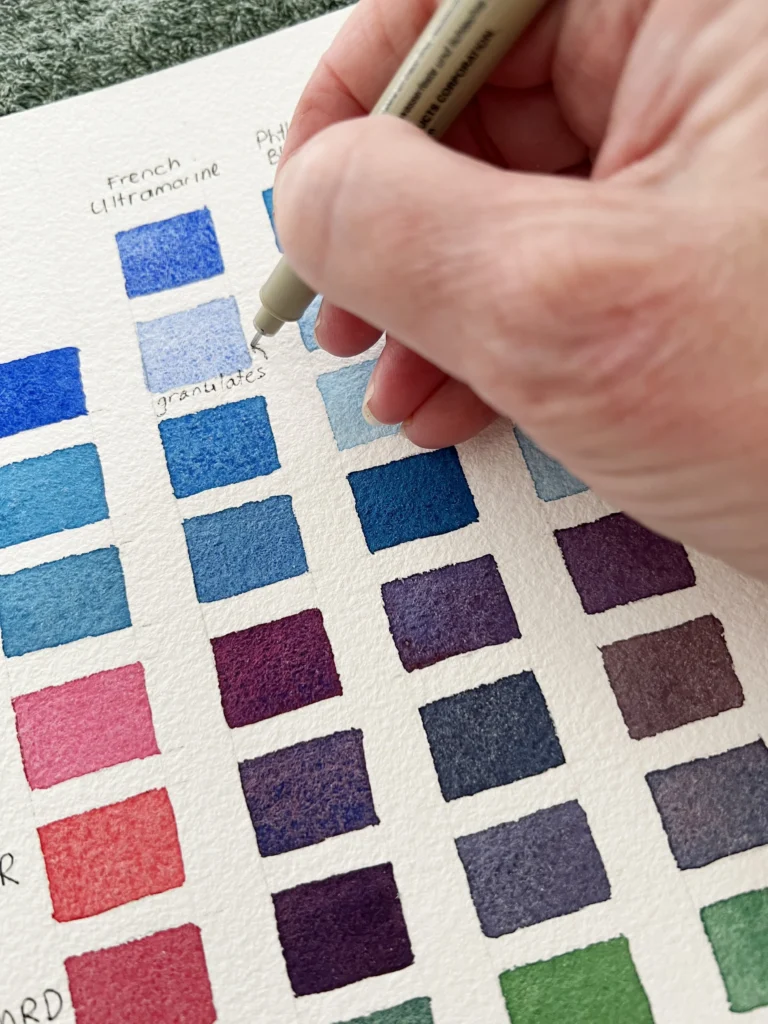
As you paint each mix, jot down small, helpful notes beside or beneath the squares. Record exactly what you see:
Is it granulating? (Look at the texture of Ultramarine or Burnt Umber).
How transparent is it? (Notice the clarity of Transparent Yellow or Ruby Red).
Does it lift easily? (For example, Madder Red Dark lifts well with a damp brush, but Prussian Blue usually stains).
What is it useful for? (Note if a mix is perfect for skies, leaf shadows, skin tones, or petals).
These observations are worth their weight in gold later on. When you’re in the middle of a painting and trying to remember, “Which mix gave me that soft lavender?” your chart will have the answer.
💡 Pro Tip: Use a waterproof pen for your labels. You’ll thank yourself later if a wet brush accidentally touches your text!
If you’re new to mixing, keep a scrap piece of paper nearby to test each combination before committing it to the grid. Once you’re happy with the hue, recreate it neatly in its square. Over time, you’ll see “families” of greens, violets, and browns emerge—all sharing a natural harmony because they were born from the same limited palette.
Understanding the Color Mixes
To get you started, let’s look at a few of my favorite combinations from this 12-color palette:
French Ultramarine + Transparent Sienna: This is my go-to mix for grays and neutrals. Add more Ultramarine for a cool, moody tone, or more Sienna for warmth. It’s perfect for painting stone, fur, and subtle shadows.
Prussian Blue + Indian Yellow: This creates a vivid, glowing green that is ideal for spring leaves. If you add more Prussian Blue, it deepens into a rich, natural forest green.
Phthalo Blue + Transparent Yellow: A bright, brilliant, and clean turquoise-green. It really “sings” on the paper! Just remember to use it sparingly in nature scenes, as it can become a bit too intense if overused.
Ruby Red + French Ultramarine: A beautiful violet that layers wonderfully for flower petals. If you lean more toward Ruby Red, it becomes a warm magenta; more Ultramarine gives you a cooler lilac.
Scarlet Red + Phthalo Green: At first, this mix might look like a dull brown-gray—but it’s actually perfect for natural shadows. That is the magic of complementary colors: when opposites meet, they neutralize each other, creating believable depth rather than “flat” black.
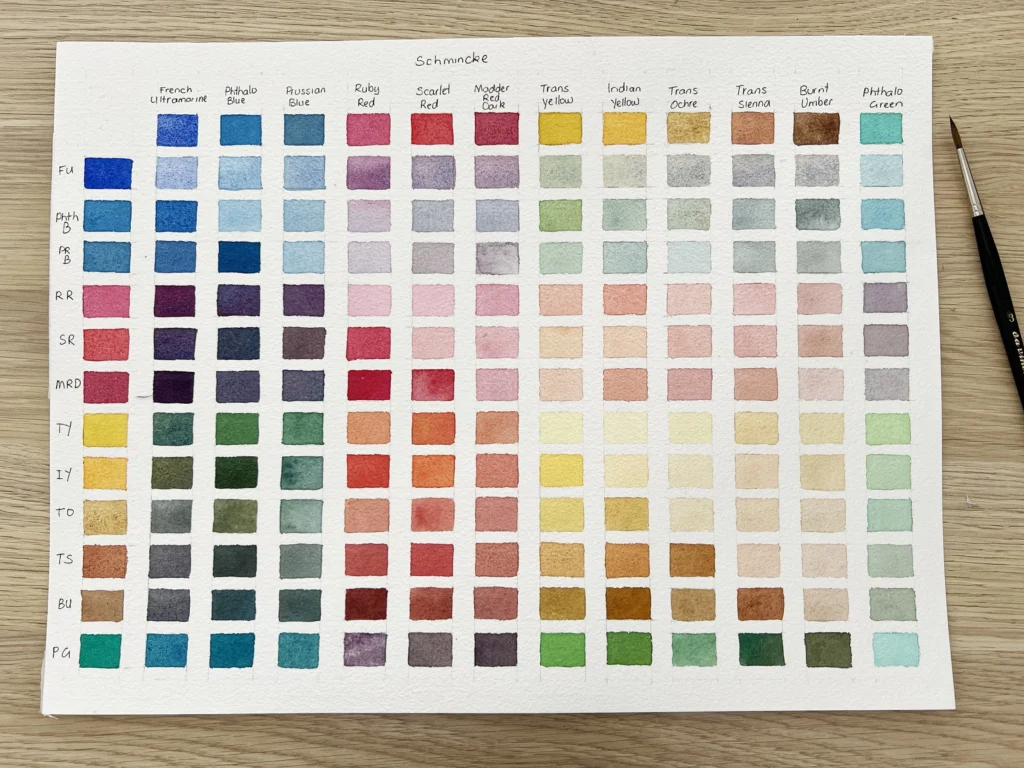
My finished color mixing chart
This is where a little bit of theory goes a long way. Every hue has a complementary color (its opposite on the color wheel). When you mix complements, you “mute” the intensity; when you mix neighbors, you enhance the harmony. Recognizing these relationships gives you incredible control over the mood and “feel” of your work.
Using Your Chart in Practice
Once your chart is dry, you’ll find it becomes one of the most valuable tools in your studio. Here is how I use mine every single day:
Planning Your Palettes: Before I start a new painting, I look over the chart to identify a few favorite mixes that suit my subject. For a warm floral piece, I might focus on Ruby Red, Scarlet Red, and Indian Yellow combinations. For a misty, atmospheric landscape, I’ll lean on French Ultramarine and Transparent Sienna.
Eliminating the Guesswork: Instead of wondering which two pigments will create a specific hue, I already have the answer. That confidence allows me to focus on my brushwork and creative expression rather than the “chemistry” of the paint.
Building Natural Harmony: Because all the colors on your chart come from the same 12-color palette, any combination you choose will automatically work together. This gives your paintings a cohesive, professional feel that is hard to achieve with random tube colors.
Refining and Extending Your Chart
Once your main chart is complete and fully dry, you can take your exploration even further. The more you experiment, the more nuanced your understanding of color becomes.
1. Glazing Tests
Some pigments behave very differently when they are layered rather than mixed. To see this in action, take a scrap of the same watercolor paper and try painting one transparent color over another once the first layer is completely dry.
For example, try glazing Transparent Yellow over a dry wash of Phthalo Blue. You’ll notice how the color “glows” much more than if you had mixed them wet-in-wet on your palette. That is the beauty of glazing: light travels through each individual layer and bounces back with incredible luminosity.
💡 Pro Tip: Transparent colors (like those in our 12-color set) glaze beautifully. Opaque colors, on the other hand, tend to look flat or “dull” when layered, so keep those for your initial washes or final details!
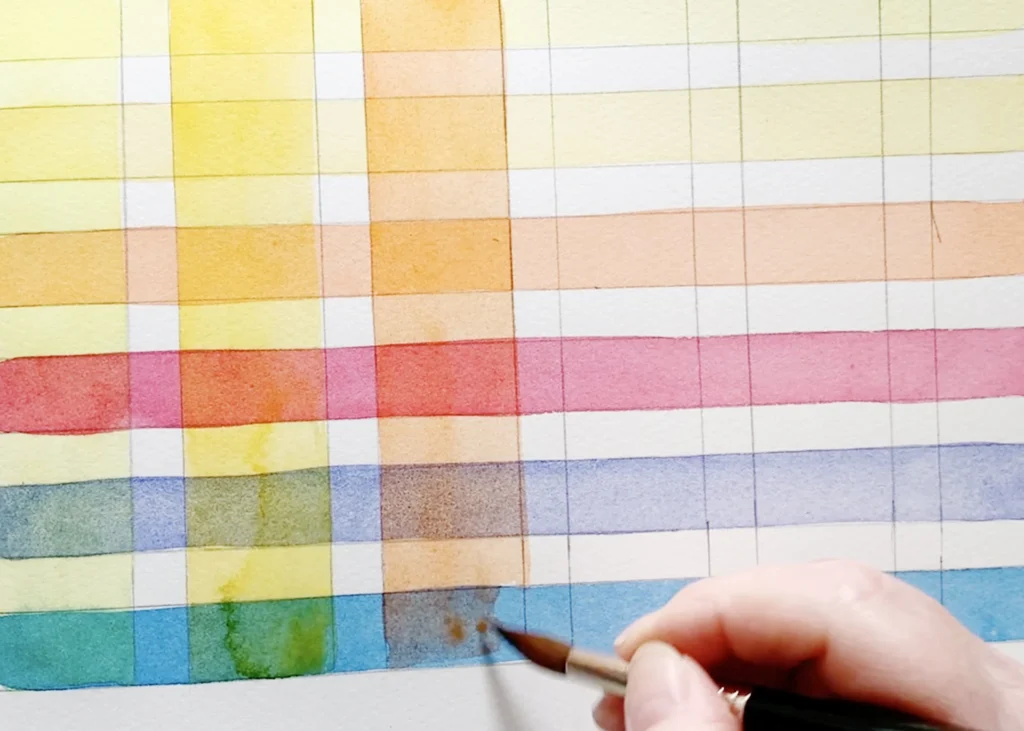
Try making a glazing chart with your colours so you can see the colours that form when you paint one colour over another.
2. Exploring Value
Beside your chart, consider creating a small value strip for each color, moving from full strength (mass-tone) to the palest possible wash. It’s often astonishing to see just how much range a single pigment holds!
For example, Prussian Blue can move from an almost-black midnight tone to the softest, misty blue-gray. Creating these strips helps you train your eye to judge exactly how much water you need to reach a specific “note”—from those bright highlights to your deepest, moodiest shadows.
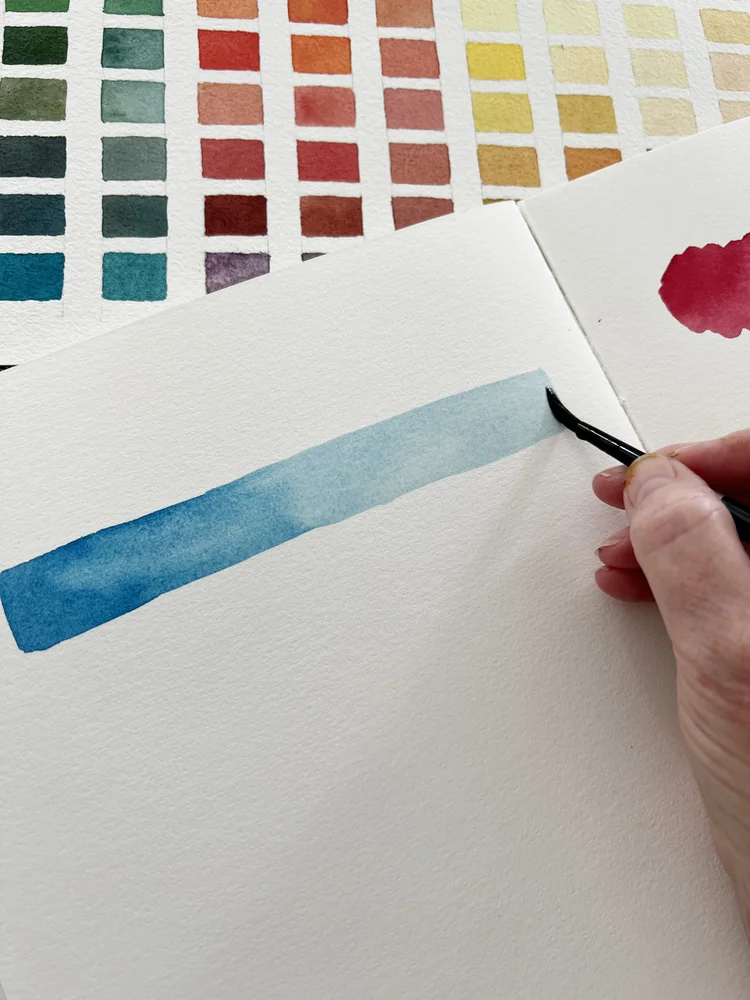
A Prussian Blue value strip shows the colour at its full intensity and how it looks when diluted with water.
3. Neutrals and Grays
If you love subtlety, try mixing pairs of complements, such as Ruby Red with Phthalo Green or Transparent Sienna with French Ultramarine, and experiment with different ratios of each.
By doing this, you’ll uncover a stunning range of gentle grays and browns that can replace pre-mixed neutrals (like Payne’s Gray or Neutral Tint) entirely. I rarely reach for a tube of gray anymore; I much prefer to mix my own from colors already present in my painting. It’s the best way to keep your work harmonized and professional.
Caring for Your Chart
Once your chart is finished, treat it like the valuable tool it is! Store it flat and somewhere visible. I like to keep mine right next to my painting area so I can glance at it whenever I’m feeling unsure about a mix.
If you decide to create multiple charts for different palettes, be sure to label them with the specific paint names and the date. Paints can shift slightly over the years, and—more importantly—so does our understanding of them!
A few creative ways to keep it handy:
Laminate it: This protects your hard work from accidental splashes or wet fingers in the studio.
Go digital: Take a high-quality photograph of your chart. You’ll always have a digital copy for quick reference on your phone or tablet.
The “Plein-Air” Trick: I’ve seen some clever artists shrink their charts down to postcard size and tape them inside the lid of their travel palette. It’s a brilliant way to keep your “mixing map” with you while painting outdoors.
A Few Troubleshooting Notes
If things don’t go perfectly at first, don’t worry! Here is how to fix common chart-making hiccups:
- Uneven washes? Try using slightly thicker paint and keep your brush moving in even, steady strokes.
- Bleeding edges? Your paper might be too wet. Let it dry for a few seconds before adding more pigment.
- Streaky squares? Use a softer brush and ensure you have enough water for smooth, fluid coverage.
- Muddy colors? You may be over-mixing or combining too many pigments. Stick to just two at a time for the cleanest results.
💡 Pro Tip: “Mud” isn’t failure; it’s a teacher. Every dull mix shows you exactly where the balance was lost. Notice why it happened, and try again more gently next time.
Beyond the Chart
Once you’ve built this foundation, your entire painting process changes. You’ll start seeing relationships everywhere—the subtle green in a shadow that’s actually a whisper of blue and ochre, or the soft pink in a petal that is simply diluted Ruby Red with a hint of Transparent Yellow.
The chart becomes your language of color. Each square tells a story—a quiet conversation between pigments. When you paint, you’re simply retelling those conversations on paper. If you ever feel creatively stuck, making a new chart is a wonderful reset. It’s meditative and grounding. It forces you to slow down, notice your paints again, and remember why you fell in love with watercolor in the first place.
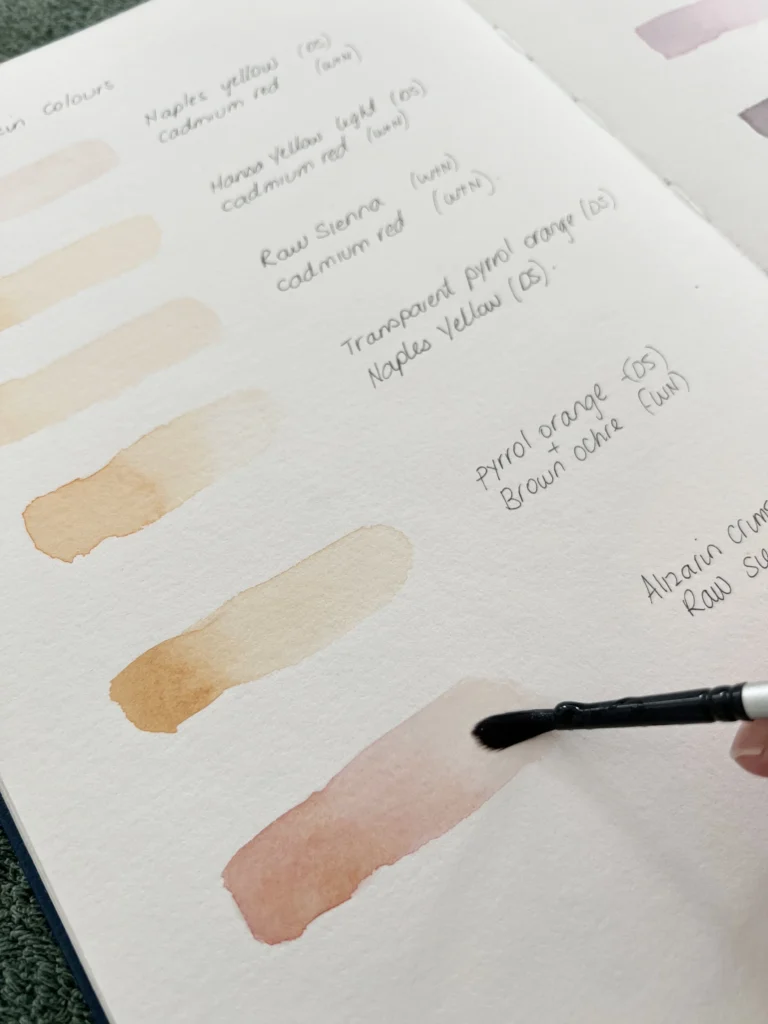
(If ruling a full grid feels too daunting, you can also dedicate an art journal to recording different paint combinations. Simply paint freeform swatches and record the colors used beside them!)
A Final Thought
Creating a color mixing chart isn’t just a technical exercise; it’s a practice in patience and awareness. It teaches you to truly see. Every square you paint is a small study in restraint and curiosity.
So, take your time. Enjoy each mix. Let this be a quiet conversation between you and your palette. When you hold that finished chart—twelve colors blossoming into dozens of beautiful new ones—you’ll realize you’ve built something far more valuable than a reference sheet. You’ve built understanding.
Don’t be afraid to make mistakes. Every unexpected hue is simply your paint teaching you something new. Keep mixing, stay curious, and above all, enjoy the process.
I’d love to see your work! If you create your own mixing chart using this Schmincke palette, please share it with me. Tag me on Instagram or send a photo through my website. Watching how differently each artist interprets these same pigments is endlessly inspiring!
Happy painting, Jennifer
